Home » Articles posted by presbyterjon (Page 5)
Author Archives: presbyterjon
Blasphemy!
My wife and I left the program with decidedly mixed feelings. On the one hand, the young people from our congregation we had gone to support did a bang-up job. The acting and singing was superb. On that level we thoroughly enjoyed the performance.
On the other hand we were, to put it mildly, bemused by the mixed message we’d gotten. I, in particular, was having a hard time processing what we’d seen and heard because of my background. The musical would have been totally inappropriate in the culture and country in which I grew up. In fact, the believers I know in that land would have been highly offended. They would have considered the musical blasphemous.
The incident got me thinking about the whole concept of blasphemy. I tend to be a bit hyper-sensitive about blasphemy because the country where I grew up now has a blasphemy law. If you happen to say anything deemed disrespectful or derogatory about the prophet of the majority religion or its holy books, you can easily find yourself facing a long time in prison, if not worse. When you’ve got that kind of thing hanging over your head, you tend to watch what you say and who you say it to. Innocent expressions, to which Americans wouldn’t give a second thought, can have deadly consequences.
With that in mind, I didn’t quite know what to make of what we’d seen and heard. For starters, the musical seemed to compare the words of Jesus to those of philosophers throughout history. But in what sense? I wasn’t sure. At first it appeared to me that the musical was saying that Jesus was simply another one of many philosophers and was on a par with them. However, the more I thought about it, perhaps it was trying to convey the message that Jesus’ words and thoughts were superior to all others. After all, the cast acted out many of Jesus’ parables and quoted verbatim almost the entire sermon on the mount. Can something which proclaims Jesus’ teaching to that extent be blasphemous?
I’ll also admit that the name of the production made me acutely uncomfortable. It was “Godspell” an obvious pun on “Gospel”. What grated on me was the implication that the “good news” of Christ was equivalent to magic. But wait! The word “spell” is merely the Middle English word for “talk” or “speech”. It was later that spell came to mean “words of power” and was associated with magic. Is it possible that the author of the musical was simply looking for a clever way to say, “This is God’s word”? Was he trying to say, “These are God’s powerful words”? Perhaps it was the author’s way of restating Hebrews 1:3? With the connotations the word “spell” has these days, the pun in the title may be in poor taste, but I can’t really say that it’s blasphemous.
What is blasphemy, anyway? We usually think of blasphemy as speech which is directed against God. To be sure, the Bible does define it this way. It is speech which mocks, insults or reviles. It’s helpful to me to think of blasphemy as the opposite of confession. The core idea of confession is saying the same thing as God. For example, when we confess our sins, it is not just acknowledging that we did something contrary to God’s expectations, or that we didn’t live up to His expectations. Confessing sin really means that we say the same thing about our sin as God does. Similarly, when we confess Christ, we say the same thing about Him as God does. In contrast, blasphemy is a deliberate misstatement or misrepresentation of God’s character or words.
However, blasphemous words may only be a symptom of the real problem. While the Bible does associate words with blasphemy, it also gives another definition. Numbers 15:30 defines blasphemy as sinning defiantly. In Ezekiel 20:27 God defines blasphemy as forsaking Him or being unfaithful to Him. Romans 2:23-24 associates blasphemy with breaking the Law.
With that in mind, I have to ask who is most guilty of blasphemy – the person who uses God’s name in casual cuss words, or those of us who call ourselves by Christ’s name yet still have a worldly lifestyle? Is it a musical that portrays the sermon on the mount which is blasphemous or we who refuse to do what the sermon tells us we ought? Something to think about.
Pi-Dog Miracle
Perhaps one of the most perplexing conundrums people face is the notion of free will, on the one hand, and the sovereignty of God on the other. Unless people have true freedom of choice, how can God possibly be just in punishing anyone for doing evil? How can God hold them responsible for something which God made them do and in which they had no choice?
On the third hand, both good Calvinists and Muslims maintain that if things can happen which are contrary to God’s will, it means that God is not totally sovereign – His power is diminished.
The answer is, of course, that though God is totally sovereign, He has deliberately limited His own power, for a time, to allow people genuine choice. Nothing can happen that God does not allow, but He allows things which are contrary to His will. Because God allows people to choose He can also, with perfect justice, hold them accountable for their choices.
This raises some interesting questions. To what extent does God withdraw Himself from human history? We all know that He allows horrible, even cataclysmic, things to take place. Yet Christians also have Jesus’ promise that nothing can take us out of His and the Father’s hand (John 10:28-29). Paul writes that nothing can separate us from Christ’s love (Romans 8:35-39), and the writer of Hebrews assures us that God will never forsake us (Hebrews 13:5-6).
Since we have these promises of God, by what means does He intervene in our lives? Hebrews 1:14 raises an intriguing possibility. There it says that angels are sent to serve those who will inherit salvation – that is, Christians. Another passage hints that we may actually encounter angels without our knowing it (Hebrews 13:2).
Though each of us has free will, and that means we may have to suffer as the result of someone else’s exercise of their freedom, I suspect that God probably interferes in our lives (or rather, directs or intervenes in our lives) far more than we realize. I also suspect that we often do not recognize the agents of divine intervention. We would probably be shocked and humbled if we knew what all God has spared us from and what forms His angels have taken while ministering to us.
These ideas and themes found their way into the novel I wrote last November during National Novel Writing Month. In it a guardian angel takes an unusual form (unusual as far as I know, that is!). Hence the title of the book: Pi-Dog Miracle.

One of the possible consequences of free will (it was not inevitable) is that people will choose to do what is wrong. A major purpose of Jesus’ coming was to redeem us from the results of our sinful choices. In addition to Christ’s sacrifice, redemption takes many forms depending on the circumstances and the individual. This, too, is one of the major themes in the book.
The plot centers around a Bible teacher who is trying to find his equilibrium after his wife’s death. He feels God’s call to leave his home in America to set up a training program for church leaders in Pakistan. In the process of finding renewed purpose, God uses him to redeem several others. His loneliness is filled from an unexpected source.
I hope you have as much fun reading the book as I had writing it. You can get your copy from the links in the right sidebar.
Living As A Church In Covenant
How being in covenant should impact us as a church.
In a previous post, I wrote about what it means to be in the marriage covenant. In this post I want to explore being in covenant relationship with God and what that means to the church. When we realize what it means to be in covenant relationship to God, it changes our whole perspective. We learn to look at God differently. We look at Scripture differently. We look at the world differently.
It follows that when people who have learned to look at everything through the lens of covenant, come together as a church, that church will also see things differently than it did before. Imagine a church filled with people who are alive to what it means to be in covenant relationship.
Before talking about that, let’s explore the concept of covenant a little more.
Characteristics of God’s covenant with us.
1) The heart of covenant is doing what is best for the other person. When I enter into a contract with somebody, I do so for my own self-interest. In contrast, if I offer to enter into a covenant with someone, it is for the benefit of the other person.
God has offered to bring us into covenant relationship with Himself. That means that He is looking out for our best interests. He’s working for our benefit. When we understand that, it changes our whole view of God.
Many people have the idea that they have to try to win God’s favor. But if you are in covenant with Him, you already have it. We don’t have to prove that we’re good enough – the truth is that we aren’t – but God still does what is best for us. We don’t have to act like we deserve God’s goodness – we don’t – but because of the covenant He showers His goodness on us regardless of how unworthy we are, or how many times we fail.
Trying to work your way into God’s good graces is as ridiculous as trying to earn an inheritance. You receive an inheritance because you’re part of the family, not because you earned it. It’s yours because of who you are, not because of what you’ve done. If we are in covenant relationship with God, we have an inheritance because we’ve been adopted into His family – we don’t have to earn it!
2) Grace is one of the key characteristics of the covenant God makes with us. You may have heard grace defined as the difference between our efforts and the perfection which God demands. That makes grace sound passive and inert. Even worse, a lot of people have the attitude that since God will make up the difference, grace gives them a license to do whatever they like.
But grace is not a stop-gap; it is not passive; it is not a license. In reality it is an aid to help us keep the covenant. It is the power God gives us to do what is right. For example, Acts 20:32 refers to the “word of grace” as something which builds us up. Titus 2:11-12 says, “For the grace of God that brings salvation has appeared to all men. It teaches us to say “No” to ungodliness and worldly passions, and to live self-controlled, upright and godly lives in this present age,” (NIV)
Rules merely define what is right or wrong. Grace enables us to avoid what is wrong and to live right.
3) Entering into covenant always involves making a pledge. In Old Testament times, people entering into a covenant relationship would kill an animal. Then, they would split the carcass down the middle and walk between the two halves. By doing so, they were pledging to keep the terms of the covenant. They were saying, “May what was done to this animal happen to me, if I break this covenant.” For example, Jeremiah 34:18 says, “The men who have violated my covenant and have not fulfilled the terms of the covenant they made before me, I will treat like the calf they cut in two and then walked between its pieces.” (NIV)
4) There is an essential difference between the Old and the New Covenants. The Old Covenant was based on a written law. Keeping the covenant meant obeying the 613 rules that God gave Moses. It depended on human effort – and no one, except Jesus, was able to keep it.
In contrast, God describes the New Covenant this way: “…I will put my laws in their minds and write them on their hearts. I will be their God, and they will be my people.” (Jeremiah 31:33, Hebrews 8:10 NIV) The Old Covenant was external, the New Covenant is internal. When we enter into the New Covenant, our old person dies, we are baptized into Christ’s death and we are raised as a new person. As party to the covenant, we are being transformed into the image of Christ. Keeping covenant no longer depends on our own effort, but on the work of the Holy Spirit who lives in us.
Under a rule-based system our focus is on the boundaries – where’s the edge? How close to the line can I get without crossing it? In the New Covenant, we’re not worried about boundaries. Our focus is on Christ and becoming like Him. We don’t have to wonder about where the line is because we know that the closer we get to Christ – the more we become like Him – the further away from the edge we are.
With those things in mind, here are four very practical ways in which being in the New Covenant affects us as a church.
I. The Covenant Meal
In Old Testament times, eating a meal together was part of the process of entering into a covenant relationship. For example, Isaac and Abimelech ate a meal when they made a covenant (Genesis 26:26-31). When Jacob and Laban entered into a covenant relationship, they also ate a meal (Genesis 31:44-54).
What many people do not know, and I certainly did not realize until recently, is that when God entered into the Old Covenant with the nation of Israel, the covenant was not only ratified by sacrifices, but with a meal. The account in Exodus 24 reads: “…they offered burnt offerings and sacrificed young bulls as fellowship offerings to the LORD. Moses took half of the blood and put it in bowls, and the other half he sprinkled on the altar. Then he took the Book of the Covenant and read it to the people. They responded, “We will do everything the LORD has said; we will obey.” Moses then took the blood, sprinkled it on the people and said, “This is the blood of the covenant that the LORD has made with you in accordance with all these words.” Moses and Aaron, Nadab and Abihu, and the seventy elders of Israel went up and saw the God of Israel. …they saw God, and they ate and drank.” (Exodus 24:5-11 NIV)
If you’ve been in church very long at all, those words probably sound similar to some you’ve heard from the New Testament. “…The Lord Jesus, on the night he was betrayed, took bread, and when he had given thanks, he broke it and said, “This is my body, which is for you; do this in remembrance of me.” In the same way, after supper he took the cup, saying, “This cup is the new covenant in my blood; do this, whenever you drink it, in remembrance of me.” For whenever you eat this bread and drink this cup, you proclaim the Lord’s death until he comes.” (1 Corinthians 11:23-26 NIV)
Just as a meal was involved in enacting the Old Covenant, a meal was involved in enacting the New Covenant. What is the significance? I’m sure that all of you recognize the passage above from 1st Corinthians 11, refers to what we call the Lord’s Supper. Unfortunately, the words are so familiar; we’ve heard them so many times, that they lose their meaning. For example, has it ever struck you as a bit odd that Jesus would command us to remember something which we did not experience? If I were to say to you, “Remember the retreat last year?” How, could you, if you were not there? How can we remember Jesus when we haven’t seen Him; how can we remember the Last Supper since we weren’t there?
The key is to understand that for the Jewish people remembering meant something much more than merely recalling to mind. Malcolm Smith describes it this way: “…to the Greek and Hebrew mind of the first century, “remember” described something totally different. First, it was not only a mental activity, a “thinking about” a past event, but an activity of the whole person – spirit, mind emotion, and body. Second, it meant to do the past event, not merely think about it. To remember meant to re-create the past event, bringing it into the present moment by reenacting it, employing rituals and symbols to do so. Third, to remember meant that the persons remembering totally identified with and participated in all the powers and effects of the original event. Every year the people of God in the Old Testament “remembered” their deliverance from Egypt in exactly this fashion, reenacting it in the Passover meal.” (Malcolm Smith, The Power of the Blood Covenant, Harrison House Publisher, Tulsa, OK, 2002, p. 163)
The Lord’s Supper is a covenant meal. When we partake of it, we are reenacting the covenant. Here’s a very practical application of this: Do you remember what I wrote about people making a covenant pledge by walking between the halves of a sacrificed animal? Jesus took bread, and when He had given thanks, He broke it and said, “This is my body, which is for you…” When He broke that bread, He was making the covenant pledge. When we break the bread during the Lord’s Supper we reenact the pledge Jesus made. When we take the bread and eat it, we renew our covenant pledge.
There are those who say that they can’t take the Lord’s Supper because they’ve really messed up during the past week. They’ve sinned and they’re not worthy to participate in it. My friend, when you feel that way, that is precisely when you need to participate! That’s exactly why you need to renew the covenant! We don’t partake because we are worthy, but because we are unworthy. If we were perfect, we wouldn’t need to renew the covenant. But even though we sin; even though we are unworthy, God, because of His grace, allows us to reenact the covenant; He allows us to renew the pledge and symbolically applies the blood of the covenant to our hearts again.
II. Unity – Discerning the Body
There is another aspect of the covenant meal. Paul not only refers to it as the Lord’s Supper (1 Corinthians 11:20), he also speaks of it as a participation or communion. “Is not the cup of thanksgiving for which we give thanks a participation in the blood of Christ? And is not the bread that we break a participation in the body of Christ?” (1 Corinthians 10:16 NIV)
Theologians endlessly debate exactly what those words mean. But one thing all can agree on is that when we participate in the Lord’s Supper, He is there. We eat and drink in the presence of Jesus. He is at the table with us. We are eating and drinking with Him.
However, there is not only a vertical dimension to this communion, there is also a horizontal dimension to it. In the very next verse Paul writes: “Because there is one loaf, we, who are many, are one body, for we all partake of the one loaf.” (1 Corinthians 10:17 NIV) In other words, the bread that we eat in the covenant meal not only symbolizes the physical body of Jesus but, also, the church.
John Marks Hicks describes the practical implications this way: “A second level of meaning is communion with the body of Christ, the church. Paul emphasizes the oneness of the church at the table. Though many, the church is one because it shares the one bread at the table. The unity of the church is rooted in the “common union” the church shares in Christ who has made the church one. When the church eats and drinks it shares the same body and blood. By visibly eating and drinking together the church exhibits the unity of the body in Christ. When we sit at the same table, we testify to our shared experience of the shared reality of Jesus Christ.” (John Mark Hicks, Come To The Table, Leafwood Publishers, 2002, pp. 111-112)
When we partake of the communion, we declare that the church is one; it is united. And this should be a powerful incentive to ensure that it really is. Are you out of sorts with one of your brothers in Christ? Have you wronged a brother? Has a brother wronged you? Then, go to him and get it resolved so that you can truly be united, and commune together as one at the Lord’s table.
The same author I quoted above says this about eating worthily: “…to eat and drink worthily is not about private introspection, but about public action. Paul is not stipulating a kind of meditative silence on the cross of Christ or an introspective assessment of our relative holiness. On the contrary, to eat in an “unworthy manner,” in this context, is to eat in a divisive manner like that which existed in Corinth. The church must examine itself about the manner in which the supper is conducted (1 Cor. 11:28). There may be many ways to eat the supper unworthily… but the specific unworthiness in 1 Corinthians 11 is a communal problem, not an individualistic one. The church eats worthily when it eats as a united community embodying the values for which Christ died.” (Hicks, op cit., p.124)
In the Supper, we not only renew our covenant relationship to God, but also our covenant relationship to each other.
III. Ministry – Table Fellowship
There is much more which could be said about the Lord’s Supper. However, I’ll mention just one more very practical application for the church:
Even though Jesus is the Lord of lords and King of kings, He came to serve. At the last supper He gave a very graphic illustration of this. Though He was the host of the supper, He acted as a servant and washed the disciple’s feet.
What does Jesus’ example mean for us? Here is one more passage from the author I quoted above: “The table is not about power, control or authority. It is not about clerical authority. It is not about gender prerogatives. It is about mutual service and ministry. The table is where we serve each other. The table embodies the mutual love and respect we have for each other as we sit at the table with the host who served us all…
“When disciples sit at the table together with Jesus as the host, they commit themselves to imitate him. They commit themselves to be servants. Just as Jesus served us, even to the extent of sacrificing his life, so disciples commit to serve each other as Jesus served them. We cannot sit at table with fellow disciples and then fail to serve them when they are in need. We cannot commune with each other at the table and then fail to commune with each other in the sharing of our possessions to meet each other’s needs. To sit at the table and deny ministry to another is to undermine the meaning of the gospel. The table must extend beyond the worship assembly as it shapes the ministry of God’s people throughout the week.” (Hicks, op cit., p. 79)
Each week, as we reenact the covenant and eat the covenant meal, let us renew our commitment to serve one another, as Jesus served us.
IV. Giving Grace
There’s a fourth area where having a good understanding of covenant, and looking at things through the lens of covenant, will have a dramatic impact on us as individuals and as a church.
Over the years, I’ve come to really appreciate the letter to the Ephesians. In the first three chapters, Paul describes what Christ has done for us. He contrasts what we were with what we are now in Christ. We were lost; we were dead; we were without hope. In Christ we’re saved; we’ve been made alive; we have an inheritance; we’ve been brought near to God; we’re members of God’s household.
In the middle part of the letter, Paul writes about the role of the church. And, in the last part, he talks about relationships.
In Ephesians 4, the Apostle Paul places a lot of emphasis on the kind of communication Christians should practice. In verse 15 he mentions “speaking the truth in love.” In verse 25 he writes that we are to “put off falsehood and speak truthfully.” And, in verse 29 he says, “Do not let any unwholesome talk come out of your mouths, but only what is helpful for building others up according to their needs, that it may benefit those who listen.” (NIV)
Unfortunately, the NIV translation obscures an important concept in that verse. The ESV puts it this way, “Let no corrupting talk come out of your mouths, but only such as is good for building up, as fits the occasion, that it may give grace to those who hear.” In this verse Paul is contrasting talk which is unwholesome or which corrupts with talk which gives grace. In order to understand what he means by unwholesome or corrupting talk, we must first understand what he means by grace.
At the beginning of this essay I said that grace is an aid to help us keep covenant and the power God gives us to do what is right. Another way to define grace is the “blessings of the covenant.” It is the benefits which accrue to us because we are in covenant relationship. In addition, grace makes up for our shortcomings. When we are about to default on, or violate the covenant, it is grace which enables us to keep it.
In light of this, when Paul instructs us in Ephesians 4:29 to talk in such a way that it “gives grace to those who hear”, he could very well be saying that our speech should be such that it helps those to whom we are speaking, keep covenant. In contrast, then, ‘unwholesome’ or ‘corrupt talk’ is anything which would entice or encourage someone to break covenant, or make it harder for them to keep it. This idea can have a profound influence on how we talk.
Let’s apply this specifically to fellow brothers or sisters in Christ:
In verse 31, Paul says to get rid of slander. To slander someone is to make false accusations against him, or to misrepresent the facts about someone in a way which defames them or damages their reputation. You can see that slander and gossip go hand in hand.
We need to make sure that what we say about others is true; that we don’t go around spreading rumors. If we do, we’re guilty of unwholesome or corrupt talk. We are violating covenant by not extending grace either to the person we are talking about, or the person we are talking to. In contrast Peter writes, “Above all, love each other deeply, because love covers over a multitude of sins.” (1 Peter 4:8 NIV)
In Ephesians 5:4, Paul expands on the kind of speech which is inappropriate: “Nor should there be obscenity, foolish talk or coarse joking, which are out of place, but rather thanksgiving.” (NIV)
Unfortunately, we often are guilty of talking about each other, or to each other, in the three ways of talking which Paul says are out of place.
1) Obscenity – This is using crude, coarse or suggestive language. When we use such language to talk to a brother or sister in the Lord, or to talk about them, we are treating them as objects rather than as persons with whom we have a covenant relationship.
2) Foolish talk – This is more than just stupid or pointless nattering. The Greek word from which this is translated includes the idea of sin. In other words, this is talk which encourages, whether intentionally or not, ungodly thinking, wrong attitudes and wrong actions. An example of such talk would be belittling a brother’s moral scruple.
3) Coarse joking – Though the word from which this is translated does indicate ribaldry, it originally included the concept of repartee, that is, a witty reply. Paul is not condemning being witty, or the quick come-back. He’s not against stimulating conversation. Where joking or repartee becomes wrong is a) When it becomes crude or coarse. b) When it is at the expense of someone else.
This can be a real problem. Someone will tell a funny story about another’s foible or make a joke at his expense. At first it may be in all innocence on the part of the one telling the story or joke. But a put-down is still a put-down even though intended in fun. The person who is the butt of the joke may feel unappreciated, demeaned or of less worth as a result – even though that was not the intention of the joke-teller. It also plants a subtle seed in the mind of the joke-teller. If you talk about someone in unflattering terms, it can turn into your actual perception of him or her. The problem with a joke with a barb, is that the barb remains even if the joke was intended in fun. What started out as an anecdote or joke can be the “thin edge of the wedge.” If allowed to build up over time, the barbs fester and the feelings can easily strain the relationship.
A related form of speech is deliberately telling jokes that the teller knows the other person will not understand, or will misunderstand, and then making fun of him or her for not understanding. This kind of thing can also take the form of deliberately saying things, as a joke, which will set the other person off or upset them. Whatever form it takes, when we indulge in this sort of thing we are telling the other person, “I’m better than you. You aren’t up to my level.” It is particularly harmful when it is done in public.
Is it wrong to tease? No. But make sure that whatever you say in public is something positive – something which will build him or her up in eyes of others, not tear down. Deal with problems in private, and not in the form of jokes.
If obscenity, foolish talk and coarse joking are out, what kind of speech should we practice?
The giving of thanks. Just as obscenity and jokes with a barb tear down, showing appreciation and saying “thank you,” builds up. When we thank someone it says that they have value. We appreciate not only what was done, but the person who did it. In addition, saying something positive about someone helps us to think positive thoughts about him or her. Positive thoughts lead to positive feelings. One way we can strengthen our churches is to always be on the lookout for positive things to say about others. Our tongues can be a powerful tool in helping others keep covenant.
Application
1) What does the Lord’s Supper mean to you? Is it just an empty ritual that you go through every week, or do you take the time to renew your covenant relationship with the Lord and with your fellow believers when you partake?
2) Does participating in the Supper proclaim a unity that does not exist in your congregation? What will you do to heal the divisions in the body?
3) How well does the church serve the needs of those in the body? How can you improve the way you serve and minister to others?
4) What sort of talk is common in the church? Does it extend grace to people and help them to keep covenant, or does it tear down? Are you part of the problem? Do you slander or spread gossip? Think of a specific situation, or a specific person about whom you need to change the way you talk.
What Did I Agree To Do When I said, “I Do”?
A look at the practical application of covenant.
Several years ago a friend of mine opened my eyes to the importance of covenant. He pointed out that we Christians can’t really understand our relationship to Christ and God without understanding covenant. He’s right. That’s how the New Testament describes our relationship. When you get right down to it, the Bible is not so much a record of history as it is a record of covenant history. In fact, the word “Testament” which we use to label the two major sections of the Bible is simply another word for covenant.
But what is a covenant? It’s my observation that even though we are in a covenant relationship with Christ and though Christ called the Communion we celebrate – many of us each week – a new covenant in his blood (1 Corinthians 11:25, etc.), few Christians really know what a covenant is. They would be hard pressed to define it or explain covenant to someone else.
So what is a covenant?
In some ways, a covenant is like a contract in that it is an agreement between two parties. These parties may be individuals, families, nations or, in some cases on God’s part, all of mankind. Like contracts, covenants define certain benefits which accrue to the participants and also define the penalties for breaking the terms.
However, there are significant differences between contracts and covenants. Unlike contracts, covenants are put into effect through blood. They are confirmed and commemorated with fellowship meals. They usually remain in effect for life. The penalty for breaking the terms of a covenant is usually death.
But perhaps the most significant difference is that contracts are selfish. If I negotiate a contract, it will be for the greatest advantage I can get, for the least cost. In contrast, we enter covenants for the benefit of the other party. Sure, we hope to be blessed by the relationship, but our motive for entering the relationship should be love. It is to bless the other party.
Malcolm Smith provides this definition of covenant: “A covenant is a binding, unbreakable obligation between two parties, based on unconditional love sealed by blood and sacred oath, that creates a relationship in which each party is bound by specific undertakings on each other’s behalf. The parties to the covenant place themselves under the penalty of divine retribution should they later attempt to avoid those undertakings. It is a relationship that can only be broken by death.” (Malcolm Smith, The Power of the Blood Covenant, Harrison House, 2002, pp. 12-13)
This definition reinforces the fact that contract and covenant represent two different world-views. Contract focuses on self and emphasizes obligations and rights. In contrast, covenant focuses on the other party to the covenant and emphasizes promises and blessings.
Notice also the line in the definition about “undertakings on each other’s behalf.” One of the characteristics of covenant, which distinguishes it from contract, is that the parties help each other to keep the terms of the covenant. If someone is in danger of default, the other person will do whatever is necessary to help him or her remain faithful to the covenant.
The marriage covenant
Let me illustrate with the covenant of marriage. A couple stands in front of a preacher. He opens his little black book (Yes, preachers really do have them!) and proceeds to read the marriage vows from it. He asks the man something like this: “Do you solemnly promise, before God and these witnesses, that you will love her, comfort her, honor, cherish and protect her, in sickness and in health, for richer or poorer; and that, forsaking all others for her alone, you will faithfully perform to her all the duties which a husband owes to a wife, so long as you both shall live?”
After the man answers in the affirmative, he asks the woman something similar to, “Do you solemnly promise, before God and these witnesses, that you will love him, serve him, honor, cherish and obey him, in sickness and in health, for richer or poorer; and that forsaking all others for him alone, you will faithfully perform to him all the duties which a wife owes to a husband so long as you both shall live?” (Adapted from The Star Book for Ministers, Edward T. Hiscox, Judson Press, 1990)
Notice what the focus of the vows is. It’s not about getting, but giving. It’s about doing what is best for the other person. It’s about helping the other person remain faithful to the relationship. Our culture has bought into the lie that marriages are 50-50 arrangements. That is, each partner should carry 50 percent of the load or responsibilities. But covenant teaches a different reality. Marriage is not 50-50. It is 100-100. Each partner accepts full responsibility for making the relationship work. Each partner also does whatever is necessary to ease the other person’s load and help him or her keep his or her commitment.
Do you want to know how to have a happy marriage? Put the principles of covenant into practice. It’s tragic that many couples forget their covenant promise. Instead of concentrating on doing what they vowed to do for their spouse, they start complaining they’re not getting as much out of the marriage as they should. The focus becomes self instead of serving one another. They start worrying about their rights instead of what is best for their spouse. I guarantee you that if couples wold concentrate on serving each other instead of their own selfish desires, almost all marital troubles would be solved.
The New Covenant
With that in mind, is it any wonder that Christ likens the New Covenant to a marriage? “Wives, submit to your husbands as to the Lord. For the husband is the head of the wife as Christ is the head of the church, his body, of which he is the Savior. Now as the church submits to Christ, so also wives should submit to their husbands in everything. Husbands, love your wives, just as Christ loved the church and gave himself up for her to make her holy, cleansing her by the washing with water through the word, and to present her to himself as a radiant church, without stain or wrinkle or any other blemish, but holy and blameless. In this same way, husbands ought to love their wives as their own bodies. He who loves his wife loves himself. After all, no one ever hated his own body, but he feeds and cares for it, just as Christ does the church – for we are members of his body.” (Ephesians 5:22-30 NIV)
Just think how much better, deeper and richer our marriages would be; how much deeper and satisfying our church experience would be, if we followed the example of Christ and learned to give ourselves up for one another, if we could just kill off our pride and selfishness and put the good of others before our own.
It’s time we practiced covenant.
Cycles of Grace, Cycles of Judgment
Is God cruel or loving?
People have trouble enough dealing with the dilemma of why an all-powerful and loving God allows evil. Yet the Old Testament stories make it clear that God, not only allowed but, was very much involved in the events recorded there.
One mistake people make when reading the biblical accounts is to assume that just because God permits something, He condones it. However, if God allows free will, it follows that people will sometimes choose to do things which are outside His will. Not everything which occurred during this period had God’s blessing. He often rebuked people for what they did.
Though that is true, to a certain extent it begs the question. The fact is that God often, not only condoned but commanded massacres and genocide. What kind of God would do that? What sort of God would sanction bloody civil war, the destruction and looting of defenseless villages and the forced marriages of captive women?
In light of the facts, many have concluded that the God we read about in the New Testament cannot be the same as the God we encounter in the Old. How can the God who loves so much that He sent His only Son to redeem mankind possibly be the same as the vengeful, vindictive and seemingly cruel God we read about in Joshua and Judges? For example, the founder of the Foreign Legion wrote, “…Yahweh (Jehovah) is the tribal god of the Israelites. …By treating the threats and fulminations of Yahweh as the words of our God, we increase man’s misunderstanding of the divine Spirit. When we study the Gospels, we find much of the Old Testament to be at variance with the teachings of Christ.” (John Baggot Glubb, The Way of Love, Lessons from a Long Life, Hodder and Stoughton, 1974, pp. 111-115)
The problem with that conclusion is that Jesus, Himself, made it abundantly clear that the God of the Old Testament is indeed the same as His Father in heaven. For example, He said to the Jewish leaders, “…My Father, whom you claim as your God, is the one who glorifies me. Though you do not know him, I know him. If I said I did not, I would be a liar like you, but I do know him and keep his word.” (John 8:54-55 NIV)
Nowhere did Jesus ever make a distinction between the Father, and the God of the Old Testament. On the contrary, He upheld both God and the Old Testament Scriptures. He said on another occasion, “…Is it not written in your Law, ‘I have said you are gods’? If he called them ‘gods,’ to whom the word of God came – and the Scripture cannot be broken – what about the one whom the Father set apart as his very own and sent into the world? Why then do you accuse me of blasphemy because I said, ‘I am God’s Son’? Do not believe me unless I do what my Father does. But if I do it, even though you do not believe me, believe the miracles, that you may know and understand that the Father is in me, and I in the Father.” (John 10:34-38 NIV)
Not only did Jesus clearly say that God is the same in both the Old and New Testaments, He said that His actions were identical to God’s. The Father was doing His work through Jesus. “Don’t you believe that I am in the Father, and that the Father is in me? The words I say to you are not just my own. Rather, it is the Father, living in me, who is doing his work. Believe me when I say that I am in the Father and the Father is in me; or at least believe on the evidence of the miracles themselves.” (John 14:10-11 NIV)
Since Jesus does not allow any difference between the God of the Old Testament and that of the New, we who are Christians must also accept that He is the same Person. How then, can we reconcile the God of wrath and vengeance we read about in the Old Testament with the God of love and mercy in the New? The truth is that both these aspects of God’s character are revealed in both Testaments. The difference in perspective is that each Testament pertains to a different period of salvation history.
Life, An Inalienable Right?
Perhaps the most difficult aspect of God’s character to accept is His ordering the annihilation of whole peoples. To many, the death penalties imposed by the Law of Moses for some things which are widely accepted and practiced today are bad enough, but genocide? According to the Nuremberg Charter and other international criminal codes, that falls under the heading of “crimes against humanity.”
In the West, people have been deeply influenced by the United States Declaration of Independence which states, “We hold these truths to be self-evident, that all men are created equal, that they are endowed by their Creator with certain inalienable Rights, that among these are Life, Liberty and the pursuit of Happiness.” To put it succinctly, they regard life as a right which cannot be transferred to another. No one has the authority to take life away from another. Many argue that even the life of murderers and other egregious criminals cannot be taken.
But is life really an inalienable right? Leaving aside the issue of whether capital punishment is ever appropriate, there is something which those who object to God’s commands to the Israelites to destroy other peoples, forget. There is a difference of degree between mankind and God. The same Declaration which proclaims that Life is an inalienable Right also says that the Right was granted by the Creator. If the Creator is the Granter then, by definition, He is outside of the grant or stipulation.
No doubt it is true that no person is inherently more worthy than another. No one has an innate authority to take life from another. By the same token, no one has the authority to give his life into the power of another. We can see the truth of these assertions in God’s statement to Noah after the flood. “And for your lifeblood I will surely demand an accounting. I will demand an accounting from every animal. And from each man, too, I will demand an accounting for the life of his fellow man.” (Genesis 9:5 NIV) The same principle is endorsed in the Law of Moses in the commands against murder (Exodus 20:13, Deuteronomy 5:17).
However, there is another side to this. If the right to life comes from the Creator, then only the Creator has the authority to transfer that right or remove it. This means that though a person does not have authority over another’s life, God most certainly does. The Bible is clear and consistent that God is the One who gives life. “…the dust returns to the ground it came from, and the spirit returns to God who gave it.” (Ecclesiastes 12:7 NIV)
Our patent and copyright laws recognize the concept of intellectual property. An inventor or artist (and no one else) owns and has complete control over his invention or work of art. In the same way, if God is the One who grants life, does He not also have the right to take it or do whatever else He likes with it? The New Testament teaches that He does. “Does not the potter have the right to make out of the same lump of clay some pottery for noble purposes and some for common use? What if God, choosing to show his wrath and make his power known, bore with great patience the objects of his wrath – prepared for destruction? What if he did this to make the riches of his glory known to the objects of his mercy, whom he prepared in advance for glory –” (Romans 9:21-23 NIV) What is wrong for man – depriving another of his right to life – does not apply to God. As the giver of life He is fully justified in taking it whenever He chooses.
James also upholds God’s right over life as well as the limit on man’s jurisdiction. “There is only one Lawgiver and Judge, the one who is able to save and destroy. But you – who are you to judge your neighbor?” (James 4:12 NIV)
God Is Consistent
Though God has the right to take life He does not do so arbitrarily. He does not destroy nations or peoples on a whim. On the contrary, throughout human history He has followed the same pattern. When God does destroy, He does so for cause.
1) God waits until people’s wickedness is so great that He has to act.
God does not want to destroy. “Do I take any pleasure in the death of the wicked? declares the Sovereign LORD. Rather, am I not pleased when they turn from their ways and live?” (Ezekiel 18:23 NIV)
In Noah’s day, “The LORD saw how great man’s wickedness on the earth had become, and that every inclination of the thoughts of his heart was only evil all the time. The LORD was grieved that he had made man on the earth, and his heart was filled with pain. So the LORD said, “I will wipe mankind, whom I have created, from the face of the earth – men and animals, and creatures that move along the ground, and birds of the air – for I am grieved that I have made them.”” (Genesis 6:5-7 NIV)
Even so, God gave mankind 120 additional years to turn away from evil before bringing the flood upon them. The Apostle Peter writes that God waited patiently during that time (1 Peter 3:20). But the people did not turn from their evil.
God also waited 400 years to bring destruction on the Amorites. He told Abram, “In the fourth generation your descendants will come back here, for the sin of the Amorites has not yet reached its full measure.” (Genesis 15:16 NIV)
Thus we see that the destruction of the Amorites during the Israelite’s conquest of Canaan was not something arbitrary. It was the consequence of their sin from which they would not turn away.
2) God gives opportunity to repent.
A mistake which many people make is to think that the peoples whom God destroyed never had the opportunity to hear the truth. How could they turn away from wickedness if they never knew anything better? But it simply is not true that people did not have the opportunity to know God and do what was right. The fact is that if people didn’t know, it was because they chose not to know.
For example, through Noah, Christ preached to the people who lived before the flood. They died, not because they didn’t have a chance to hear the message, but because they disobeyed it when they did hear it (1 Peter 3:18-20).
The entire earth was repopulated by the eight people who survived the flood. Every one of them knew the truth. They all knew about God. Yet most of their descendants chose to turn away from Him and embrace wickedness.
Even then, the nations which embraced idolatry still retained some knowledge of God. For example, during Abraham’s day, God communicated to Abimelech of Gerar in a dream (Genesis 20:3). Melchizedek was a priest of God (Genesis 14:18). God appeared to Laban (Genesis 31:24). Moses’ father-in-law was the priest of Midian (Exodus 3:1). One of the purposes of the plagues was so the Egyptians would know the Lord (Exodus 7:5) and the other nations would learn to fear Him (Exodus 15:14-16, Deuteronomy 2:25). Even Balaam communicated with God (Numbers 22:8 and following). Yet, in spite of all these witnesses and opportunities the nations, for the most part, did not repent and turn to God.
3) God always accepted those who did turn from their wickedness.
In spite of the fact that God decreed destruction for the people of Canaan, He still allowed all those who wanted, to enter into the Covenant. There is a long list of those who did so.
Rahab and her family turned to God and were spared from the destruction of Jericho (Joshua 6:25). She is in the ancestry of Christ.
Joshua 8:35 mentions the aliens who participated in the renewal of the Covenant at Mt. Ebal and Gerizim.
The Gibeonites entered into a treaty with the Israelites and became part of the community (Joshua chapter 9). Later, God punished Israel because King Saul violated that treaty (2 Samuel 21:1).
Ruth the Moabitess renounced her gods and entered the Covenant in spite of the fact that God had instructed the Israelites not to have any ties to that nation (Deuteronomy 23:3-6). She became the ancestor of king David and, therefore, Christ.
Uriah the Hittite is one of the best examples of faith, loyalty and dedication in all of Scripture (2 Samuel 11:7-17).
David purchased the land where the Temple was eventually built from Araunah the Jebusite who is another example of faith (2 Samuel 24:18-25, 1 Chronicles 21:18-26).
Men from Gath proved to be some of King David’s most loyal troops (2 Samuel 15:18).
4) People chose to reject God.
In spite of knowing about God, and the opportunities they had to accept Him, the peoples chose to reject Him. Since they would not accept the truth, no alternative was left but to allow them to reap the consequences of their decision.
The kings east of the Jordan river chose to fight Israel even though the Israelites tried their best to avoid conflict (Numbers 21:21-35).
The citizens of Jericho were fully informed about the plagues in Egypt, Israel’s victory over the eastern kings and God’s promises to the Israelites. Instead of responding like Rahab, they chose to reject and defy (Joshua 2:2-11).
The kings in southern Canaan chose to fight against Gibeon for making a treaty with the Israelites instead of following their example and seeking a treaty of their own (Joshua 10:1-4).
Instead of seeking a peace treaty, the northern kings of Canaan chose to fight the Israelites (Joshua 11:1-5).
The Philistines learned all about God when they captured the Ark of the Covenant. They got a graphic lesson about God’s superiority over Dagon. Yet, they still clung to their idolatry instead of turning to God (1 Samuel, chapters 5 and 6).
The Broader Picture
When looked at in context, there can be no doubt that judgment fell on the peoples of Canaan because they deliberately turned away from God. He destroyed them because they would not repent and turn away from evil though they were given every opportunity and all the time they needed to do so. In contrast, those who did seek God were spared, accepted and included in the Covenant.
However, there were other considerations which made the destruction of the people living in Canaan necessary. God was not only concerned about the people of that time but about all mankind in all times. Paul teaches us that even before the world came into existence God had a plan to redeem mankind (Ephesians 1:4-10, 2 Timothy 1:8-10). The plan would not only redeem those after Christ, but also all those whom God counted as righteous before Christ (Hebrews 10:3-12, 11:39-40). To bring that plan to completion, it was essential that the Israelites be kept separate and distinct from all others.
Why the Israelites? We don’t know all the reasons why. God doesn’t give us a complete answer. We can say this much that starting with Abraham, they were the lineage of faith. More people from them than any other branch of the human race sought and trusted in God. That in itself would have made them unique.
Though Scripture does not say this, I suspect that another reason God chose to bring His plan to fulfillment through the Jewish people is that they were the ones who kept the accounts of what happened. Though at one time all the peoples of the earth knew the stories of how God had created the universe, how sin entered the world, the flood and what happened afterwards, only the Israelites preserved them. All other cultures forgot the truth or distorted it with myth. In spite of all their rebellion, their flirtations with idolatry and their attempts to assimilate themselves into the surrounding cultures, a remnant always remained faithful to God and the Covenants. There was always someone who kept the record. Someone always kept the witness and testimony alive.
If God had not chosen the Israelites, He would have had to select another people to fulfill the plan. And, whether it was the Israelites or someone else, God had to keep them distinct and separate. One of the reasons, which is repeated time and time again, for annihilating the inhabitants of Canaan, is so they could not lure the Israelites away from the Covenant and, therefore, away from their part in God’s plan in redemption. For example, “When the LORD your God brings you into the land you are entering to possess and drives out before you many nations – the Hittites, Girgashites, Amorites, Canaanites, Perizzites, Hivites and Jebusites, seven nations larger and stronger than you – and when the LORD your God has delivered them over to you and you have defeated them, then you must destroy them totally. Make no treaty with them, and show them no mercy. Do not intermarry with them. Do not give your daughters to their sons or take their daughters for your sons, for they will turn your sons away from following me to serve other gods, and the LORD’s anger will burn against you and will quickly destroy you. This is what you are to do to them: Break down their altars, smash their sacred stones, cut down their Asherah poles and burn their idols in the fire. For you are a people holy to the LORD your God. The LORD your God has chosen you out of all the peoples on the face of the earth to be his people, his treasured possession. The LORD did not set his affection on you and choose you because you were more numerous than other peoples, for you were the fewest of all peoples. But it was because the LORD loved you and kept the oath he swore to your forefathers that he brought you out with a mighty hand and redeemed you from the land of slavery, from the power of Pharaoh king of Egypt. Know therefore that the LORD your God is God; he is the faithful God, keeping his covenant of love to a thousand generations of those who love him and keep his commands. But those who hate him he will repay to their face by destruction; he will not be slow to repay to their face those who hate him.” (Deuteronomy 7:1-10 NIV)
God Is Still The Same
God was fully justified in destroying the peoples of Canaan during the time of the Conquest and Judges because it was His right as the Creator, they would not turn from their wickedness and enter the Covenant, and it was necessary to fulfill God’s plan to bring salvation to all mankind. However, there is something we, who are accustomed to look at God through the lens of the Gospel, tend to forget: God is still the same. He does not change. The God who brought destruction upon the Canaanites is the same God who offers us salvation through Jesus Christ.
Throughout history the cycle is the same. God offers, mankind rejects, God waits patiently, God brings judgment.
While reading the Bible we need to keep in mind that different portions of it deal with different portions of the cycle. The aspect of God which is portrayed will vary depending on which part of the cycle is recorded. When we read the books of Joshua and Judges, we are looking at a judgment section of the cycle. Therefore, God appears harsh and vengeful. When we read the New Testament, we see the part of the cycle where God offers. There we see more of God’s love.
But God is still the same. Even in judgment we still see glimpses of His love. Even when He woos us with the offer of pardon through Jesus Christ we can still see glimpses of His severity. The aspect of God’s character we ultimately experience depends on us and how we respond to His offer of a covenant relationship.
What Kind Of People?
The Canaanite people experienced God’s judgment during the Conquest and time of the Judges. The Israelites experienced God’s judgment at the time of their Exile. Today, we are in another cycle. God has made His offer. He has presented the Gospel to us. We have the opportunity to enter Covenant through the sacrifice Jesus made on our behalf. Now God is waiting patiently for those who will respond. In the meantime, mankind continues to travel down the road of corruption and wickedness. One day, the judgment portion of the cycle will come again. Only this time, the judgment will be final. There will not be another offer. The final and complete sacrifice for our redemption has already been made. Another one will not be made.
The Apostle Peter sums it up this way: “The Lord is not slow in keeping his promise, as some understand slowness. He is patient with you, not wanting anyone to perish, but everyone to come to repentance. But the day of the Lord will come like a thief. The heavens will disappear with a roar; the elements will be destroyed by fire, and the earth and everything in it will be laid bare. Since everything will be destroyed in this way, what kind of people ought you to be? You ought to live holy and godly lives as you look forward to the day of God and speed its coming. That day will bring about the destruction of the heavens by fire, and the elements will melt in the heat. But in keeping with his promise we are looking forward to a new heaven and a new earth, the home of righteousness. So then, dear friends, since you are looking forward to this, make every effort to be found spotless, blameless and at peace with him.” (2 Peter 3:9-14 NIV)
What kind of people are we, indeed? Are we at peace with God?
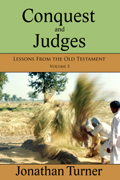
Note: Except for a few changes, this essay is excerpted from my book Conquest and Judges. You can buy a copy of the whole book by clicking on one of the links in the right panel.
Outcasts All
Everyone has a message he or she needs to share.
There’s a saying in church circles that everyone has at least one sermon in him. What I mean when I use the expression is that each person, no matter how long he or she has been a Christian, is passionate about at least one thing, one topic. Each person has a message which he or she feels other Christians, or the church as whole needs to hear.
The message might be a very positive one, for example, an aspect of God’s blessing or His grace which this person understands or has experienced more than others. It might be a message of encouragement and hope when others are in despair. It might be a message of comfort in the face of distress and grief. It might be a message to motivate. Or, it might be a message of rebuke to the complacent or those who are drifting away.
The tragedy is that most people never have the opportunity to share that special message with the rest of the church. All too often not only our assemblies and classes but the whole congregation are dominated by one or two individuals who do the speaking. At best, someone with a message that others need to hear might get to share it in a small group.
The lack of opportunity for people to express what is on their hearts has at least two unhealthy consequences. The first is that the church never gets to hear their message. And, because we never hear those messages, we remain bereft of much wisdom, guidance, insight and encouragement. Scripture tells us not to quench the Spirit (1 Thessalonians 5:19). Yet how many times do we do precisely that because we have cut ourselves off from the guidance the Spirit is trying to give through the agency of someone whose voice the church has stifled? How ironic that we, as a church, pray for leading and direction, yet so often are blind and deaf to it unless it happens to come through the “anointed” few we allow to occupy the pulpit!
A second unhealthy consequence of stifling the voices in the congregation is that people do not get the opportunity to develop their gifts and talents. In just about all the congregations I have attended, there is a perpetual lack of teachers, counselors, encouragers, exhorters, and those who know how to share their testimony. Yet, many of the same people who seem so incompetent in expressing themselves in spiritual things, perform well in their jobs. Why are they competent at work but not at church? I suggest it is because we have not allowed them to be. How can anyone grow and develop without opportunity, without practice? People don’t have confidence in their ability to express themselves because we haven’t given them the opportunity to do it.
There’s a corollary to this. I read someone, it may have been Tozer, who pointed out that each Christian inevitably feels lonely and isolated. The reason is that we all grow in our spiritual walk at different rates. As a result though we are all in Christ, to a certain extent, we travel alone. I suggest that there is another reason Christians feel alone and isolated. It is because their voices are not heard. They walk in silence, unable to express that one sermon or message God has given them. Even though they are in God’s family, they feel like outcasts, pariahs because they have no voice.
Everyone Has a Story
What got me started on the above rant is that there is a similar saying in the literary world. “Everybody has at least one novel in him.”
There are an awful lot of people out there who want to write a book. Many of them have been toying around with a concept or a plot for years. The problem is that very few people ever get anything down on paper. Someday they’re going to sit down and write it out, but someday never comes. Of those who do start to write, very few ever finish.
I was no different. Over the years I’ve had ideas for several novels. I even did a fair bit of research for one of them. But somehow, I never got around to writing anything except for a few notes and the beginning of one scene. Though the idea of writing a book was very alluring, actually doing it was daunting. There was always a good reason to put off the writing for another day.
Then something happened which changed everything. About a year or so ago I heard about a program that encouraged people to write a complete novel in a single month. Since the month was already over by the time I heard about it, I more or less shrugged my shoulders and forgot about it. And really, writing an entire novel in a month? The whole idea seemed rather preposterous anyway.
However, every once in a while I’d run into another mention of this annual event. Finally, I decided to do a little research and found the website. It turns out that National Novel Writing Month is not the fly-by-night gimmick I had thought it might be. Every year, hundreds of thousand of people from all over the world attempt to write a novel of at least 50,000 words during the month of November.
My daughter encouraged me to make the attempt. So eventually, with some trepidation, I signed up. With the exception of a few short stories, all of my writing has been non-fiction. Since articles and lesson plans generally take me several days to complete, I honestly didn’t know whether I’d be able to write 50,000 words in only a month. I also didn’t know whether I could come up with a story that long. I didn’t know whether I’d be able to force myself to work through those times when the words just don’t want to come.
Much to my relief, and somewhat to my surprise, the writing came fairly easily. In fact, I found that I was able to write enough each day to get ahead of the game. My novel came in at a little over 53,300 words, and I finished it early. I am now an official winner. I was amazed at what a sense of accomplishment that’s given me.

Why write about this? Because in the process I learned some things about achievement and motivation which I think are directly applicable to the problem I mentioned earlier – allowing people in the church to deliver their message.
A Positive Culture Which Breeds Success
What makes NaNoWriMo successful? Here’s what I observed:
1) They break the task down into achievable steps. 50,000 is a large number. Thinking of writing that many words is daunting. If the goal of 50,000 was the only thing they held before us, I doubt that many people would even attempt it. Instead, they broke the number down into an average daily word-count that would add up to 50,000 by the end of the month. Yes, 50,000 is daunting, but 1,667 words in a day is very achievable. I ended up averaging about 2,200 a day, roughly four pages, and I am not a fast typist.
In the context of church we, all too often, expect people to somehow automagically become fully formed and competent speakers and teachers from their first attempt. This is what happened to me 30 years ago. I had no experience, yet one day the preacher told me I was going to be the teacher of a youth class. Total cold-turkey. To say it was daunting doesn’t begin to capture the terror I felt. How much better it would have been if the task had been broken down into small, incremental steps and he had allowed me to build up to it!
2) They celebrate milestones. There’s a section in the NaNo forums for what they call shoutouts. People may still be a long way from reaching 50,000, but they’re encouraged to let others know when they’ve reached a goal which is significant to them. Reached 5,000? Let people know! Hit 25,000? Take some time and celebrate making the halfway mark!
As Christians, our goal is to become like Christ. That’s daunting. It doesn’t happen all at once. There may be many areas in our lives where the Holy Spirit still has significant work to do. But how often do we allow people to celebrate the mileposts on the journey? Do we let them share their victory over that habit? How can we rejoice with them when they are able to master their temper if we never hear about it?
3) They applaud progress and growth rather than dwell on failure. There are a lot of people who don’t make the whole 50,000 words. Sometimes, people have tried for several years and still can’t do it. However, one thing I noticed, both on the NaNo site itself and in the forums is that there are no put-downs. Instead there is positive appreciation and encouragement for whatever has been accomplished. Did someone only manage to get 800 words written? Instead of chiding them for not putting out 49,200 more, they congratulate the person for the 800 they achieved. Hey, it’s 800 more than you had before! That’s good!
How often at church do we concentrate on what people have not done, or the distance they still have to go, and ignore the progress they’ve made? How often do we express appreciation for honest attempts to grow in the Lord? Do we congratulate people for the progress they make in becoming a better speaker or expositor, or do we continually point to their weaknesses and how far they still have to go in order to meet whatever standard of competence we’ve created?
4) They provide help for those in trouble or who are discouraged. There are many potential pitfalls for the would-be novelist. Perhaps we suddenly realize that we have no idea how to train a dog or fix a computer. Perhaps we don’t know proper operating room procedure. Maybe we don’t know what all a pilot checks off on his list before takeoff – or a million other bits of data that we need to stick into our novel in order to make it believable.
Perhaps we have all the facts and procedures we need down pat, but are having trouble with plotting, structure, character names or…
Maybe we just get discouraged with the whole process. The words aren’t flowing as we’d like. Or, we’ve written ourselves into a corner with no visible out and feel like throwing in the towel.
There are sections in the forums to help in all these situations, and more. People are willing to help you chase down that elusive fact. They can make suggestions on structure or how to express an emotion. There are suggestions to help with character names. Most of all, they are willing to lend an ear or a shoulder to lean on when the whole process just gets to be too much.
It’s made me wonder how supportive we are to one another in church. Do we listen? Are we willing to help out when someone has a question? Can we offer advice? Do we have a word of encouragement when the going gets rough? Doesn’t Scripture say something about spurring one another on to good works? Doesn’t it tell us to bear one another’s burdens?
5) They do not insist on conformity. The stated intent of NaNo is to write a novel. The stated goal is to churn out 50,000 words in one month. However, there are a substantial number of people who don’t want to write fiction. Instead they want to work on their memoir, or a cookbook or some other non-fiction project. Some want to write short stories rather than a novel. Instead of aiming for 50,000 words, some just want the discipline of writing each day. Some set goals of as little as 200 or 300 words a day. The point is that there is room for all these people in the NaNo tent.
Now I’m not trying to suggest that when it comes to church there are no standards. I’m certainly not saying that we should be inclusive to the point where we look the other way from sinful behavior. No, there can be no compromise in exhorting people to live holy lives. Becoming like Christ is not an option – it is the essence of our covenant relationship with God. Scripture also tells us to be like minded.
However, there are areas where I think we harm ourselves and the church by insisting on conformity in non-essentials. I’m thinking in particular about speaking styles. How often have voices been silenced because they didn’t line up with someone’s preferences? A person isn’t “dynamic” enough to address the congregation. Someone else dares to use a “teaching” style and engages the congregation in dialog rather than the approved “preaching” monologue. Another person likes to pace, or puts his hands in his pockets or… I’ll let you fill in the blanks.
I can’t help but wonder how much the church has missed because it won’t listen to someone who doesn’t fit the approved stereotype. How much depth could we have gained if we were willing to hear people coming at Scripture from different, but still very valid, perspectives. What riches have we missed by not listening to the “small, still voice?”
6) They provide a true sense of community. One of the things which makes NaNo work is that the people who participate have a real sense of doing this thing together. Periodically, the originators or sponsors will email pep-talks and encouragement to everyone. They remind us that we’re in this thing together and that we’re not alone when we face obstacles and challenges. There are parties where people are encouraged to talk about the novel they’re working on. There are write-ins where people who live in the same geographic area get together in the same location and write. And so on.
Our church assemblies and small groups are supposed to give us that sense of community as well. To some degree they do. Yet all too often, I’m afraid, we don’t have that sense of all going the same direction, of all striving for the same goal. Part of the problem is, I think, that we often forget what the goal is – becoming like Christ. Instead we get side-tracked by secondary, sometimes trivial, issues which not every one can agree on. Instead of our assemblies drawing us together, they give us the sense that we’re headed down different roads.
But another reason I think we often don’t have a sense of community is that we’re prevented from communicating. Most of the communication which does take place in our assemblies is one-to-many instead of the rich, many-to-many communication we catch glimpses of in the New Testament. Whatever the reason, all too often, we end up feeling like outcasts instead of like the family we’re supposed to be.
7) They trust, yet offer validation. NaNo is based on trust. If you say you’ve written 15,782 words, they take your word for it. Your progress bar (which is visible to everyone if you post to the forums) will show whatever word-count you happen to supply from day to day. They figure that the only person you hurt if you cheat, is yourself. On the other hand, if you want to officially be counted as a winner, and get the certificate, you have to validate your word-count by pasting your novel into the official word counting tool on the site. Even then, no one checks to make sure you haven’t just copied one word 50,000 times.
I wonder sometimes how much further along we would be in our congregations if we had more of a culture of trust. I freely admit that it’s sometimes hard to give people the benefit of the doubt. It can be hard not to suspect motives. But we have to remember that Christ is the Master, not us.
A Matter of Quality
“But what about quality?” you ask. “It’s one thing to bang out 50,000 words in one month, but how good are they? Will your novel be worth publishing?”
In most cases, probably not. I don’t know whether my novel is any good or not. Authors are notoriously unable to judge the quality of their own work.
But if you can’t be sure of the quality of what you have at the end of the month, then what’s the point? The point is to turn off the inner editor and critic and just get the words down. The people at NaNo point out that you have to have something to edit. If you never get the words out, you can’t correct them. Remember what I said earlier about most people never writing their stories at all?
But there’s another point, too. You only get good at something, no matter what it is, through practice. Your first novel or two may be dreadful, but each one gives you more practice. It’s only by doing that you discover what works and what doesn’t. It’s only by writing that you discover your unique “voice” which distinguishes you from all other authors. It’s only by practice that you learn to use the “tools” of your trade.
This concept has a direct bearing on our church experience. We want competent, fluent and articulate teachers and speakers. Yet how can they ever develop those skills and talents unless we give them opportunity to do so? We complain about the incompetence of our people, yet withhold from them the very things they need (opportunities to practice and develop their skills as well as constructive criticism) in order to gain competence.
“What’s your novel about anyway?” Glad you asked. It’s about a teacher who is asked to set up a training program for church leaders in a foreign country. The working premise is that, in one way or another, we’re all outcasts. Through various circumstances, God fills the voids in our lives and shows us that we belong. “‘…I will restore you to health and heal your wounds,’ declares the LORD, ‘because you are called an outcast, Zion for whom no one cares.’” (Jeremiah 30:17 NIV)
Law vs. Spirit
What motivates us to do right?
My daughter aspires to a career writing children’s literature. I think she’ll succeed. She has a good imagination, she’s developed a unique voice in her writing and has the necessary discipline to park fundament in chair in front of computer for the requisite time to capture her plots. Where she may have some trouble is on the business side of things. You see, these days there are too many choices to make. It isn’t like the old days when there was basically only one route to publication.
A Matter of Choice
She and I were talking about the revolution which is going on in the publishing industry due to digitization. I was reveling in the choices writers have compared to the past. I’m excited by the fact that I can bypass the old “gatekeepers” when publishing my books. I like having control over the formats and formatting, choosing cover art and where to upload the finished product. It amazes me that I can make my work available to the whole world without having to give away a (large) percentage of my rights and royalties. The down side, of course, is that if something goes wrong I have no one to blame but myself.
My daughter is not so enamored of the new publishing landscape. She doesn’t like the fact that the old wisdom no longer applies. Though she would like having a say in formats and cover art, she doesn’t think the ability to bypass the gatekeepers is a good thing. She feels that no one should be published unless they’ve “paid their dues.” She would be more comfortable if there was only one route to publication like there used to be. She said something to the effect of, “I like it when there are rules. Just tell me what to do, give me the procedure, and I’m good with that.”
There are a lot of people who like order and an established way of doing things. Too many choices and the responsibility for making those choices are frightening. Too many variables can lead to computational overload, indecision or even paralysis.
Fortunately, this does not extend to all areas of life and not all people are affected the same way. In other areas, my daughter deals with complexity and choices just fine. While I revel in the choices I have in publication, a trip to the grocery store can give me sensory overload. I like choice, but how can you choose between fifteen varieties, styles and brands of string beans? From my perspective, it would be better to only have two or three to choose from.
Rules and Disputable Matters
Having to choose vs. following established guidelines and parameters has profound implications in spiritual things, also. Let me explain. I was teaching a class on Christian living, that is, how being in Christ should impact the way we live. The question came up how we should determine what we ought to do in what Paul calls “disputable matters” – those areas where there are no clear directives in Scripture.
I explained that the proper way to approach such problems is to look in Scripture for principles which might apply. Then, make your decision based on those principles. Act on what you know, retain an open mind and modify your decisions and your behavior as you gain further insight. I also took the class through several examples of this methodology.
Inevitably, the question of alcohol came up. Someone in the class asked whether it is alright for Christians to drink and, by the way, “What is the church’s position on this?” It surprised and disconcerted me that some in the class wanted me to issue a ruling. Was drinking permissible and, if so, how much?
On another occasion I taught a seminar for church leaders. To demonstrate the absolute necessity for humility in leaders, my co-teacher and I washed the participant’s feet. They were fascinated by this and asked a lot of questions. I was disappointed that the most pressing issue on their minds was how often foot-washing should be done. They wanted to take something intended as an object lesson and turn it into a ritual.
In both these cases the attitude was, “Just tell us what to do and we’ll do it.” The motives were good. They wanted to do what is right. But they missed the whole point.
I refuse to legislate where Scripture does not. In many cases it would make life easier – at least in the short term, but in the long-term it would be self-defeating. People might be willing to follow rules, but following external rules does not develop conviction. Right behavior which reflects inner character is far more valuable than right behavior produced by external coercion. When the chips are down, people will always act according to what they really believe – not according to something imposed from the outside.
No Rules = Soft on Sin?
Refusing to impose rules can also lead to misunderstandings and awkward situations. People sometimes assume that by not making a rule against something you condone the behavior, or that you are soft on sin. For example, I was taken to task for not forbidding someone from smoking. My reply was that it is a matter of spiritual growth and conviction. The person in question did not yet understand the sinfulness of his behavior. If I were to forbid his smoking and he complied, it would not be from conviction. (If I forbade and he did not comply, then it raises the stakes and becomes a matter of church discipline.) Far better to extend grace until the Spirit convicts him in this particular area. Then we can work together, rather than at odds, in overcoming the habit. And, by the way, would you like me to make some rules about your behavior in areas that the Spirit has not yet convicted you about? If not, then allow the same grace to others.
It’s not up to me to do the Spirit’s job. My responsibility is to teach biblical truths and principles and let the Spirit do any convicting which may be necessary. Please don’t misunderstand. I’m not at all saying that we should be “soft” on sin or that we should not confront people when they are doing what is wrong. Far from it. I’m not talking about unambiguous sins, but about things that are not necessarily crystal clear – the “disputable matters.” Where there are clear directives we need to point them out and expect people to comply. For example, Scripture is very clear that Christians are to avoid getting drunk (Ephesians 5:18). The stated reason in that verse is that it leads to debauchery. There are other Scriptures which also lend support to this directive. Therefore, if a fellow Christian does get drunk we not only have the right but the responsibility to confront him or her with his or her sin. However, even then, we must do it gently and with the intent to restore rather than condemn (Galatians 6:1-2).
Paul’s Example
It’s instructive to think about how Paul dealt with this business of legislation vs. the operation of the Spirit while confronting the situation in the churches of Galatia. False teachers had infiltrated the churches and told the Christians that they had to observe the Mosaic Law if they wanted to please God. Bear in mind that this was not a “disputable matter.” The very character of the Gospel was at stake. Yet, Paul did not deal with the situation by issuing rules and directives. Instead, he appealed to the people’s experience of the working of the Spirit. “Are you so foolish? After beginning with the Spirit, are you now trying to attain your goal by human effort? Have you suffered so much for nothing – if it really was for nothing? Does God give you his Spirit and work miracles among you because you observe the law, or because you believe what you heard?” (Galatians 3:3-5 NIV) Later in the letter he tells them to live by the Spirit (Galatians 5:16-26).
Assuming, as I do, that Paul wrote the letter to the Galatians after the Jerusalem Council which is recorded in Acts 15, why didn’t he settle the matter by simply referring to the letter that the Jerusalem church wrote to the Gentiles? Didn’t that ruling solve the problem for all time? We know that Paul agreed with the letter for he delivered it to several churches (Acts 16:4).
Why, then, didn’t Paul cite the ruling of the Apostles as final when addressing the churches in Galatia? Had Paul merely pointed to the letter the Council had written, it would have been easy for people to regard it as a replacement for the Law. The result would be to substitute one law for another. Paul was after something much more profound. He wanted people to experience life in the Spirit. He didn’t want them to think in terms of rules and boundaries but of becoming like Christ.
Led by the Spirit
The Law kept people in line through external rules and regulations. In Christ we do what is right because He has given us a new nature. That new nature inherently does not want to do anything which is contrary to God’s will. This is the fundamental difference between the Old Covenant and the New. The Old is based on compliance to an external standard. In the New, God’s laws are written “on their hearts” (Hebrews 8:7-13). We are being transformed into the image of Christ (2 Corinthians 3:18) and the more we become like Christ the less we need rules to govern our behavior. We will automatically do God’s will.
I’m fully aware that in some respects it’s a whole lot more comfortable to have a bunch of rules. It makes life simpler. In X situation, you’re supposed to do Y. But the day inevitably comes when none of the rules seem to fit. Then what are you supposed to do?
On the other hand, it can be very disconcerting if there aren’t rules. “You mean I have to understand principles and figure out what to do based on them? It’s so confusing!” It may be difficult; it may be confusing; it means we have to actually think instead of leaning on somebody’s list of guidelines. But, if we can learn to recognize the direction of Christ’s Spirit who lives in us, we’ll find that we will know how to act all the time, in every situation. We won’t go far wrong if in everything we ask, “Will this make me more like Christ?” “Will it bring glory to Christ?” Is this how Jesus would act?”
Why Aren’t Christians Nicer?
We are works in progress. Jesus didn’t come for those who don’t need help.
One of the arguments I’ve heard against Christianity is, “If Christianity is true, then how come so many people who aren’t Christians are nicer than those who are?” I can answer that question because I happen to be one of those people who struggles with character flaws. You see, I tend to be a cynic. It’s easy for me to slip into the habit of seeing the negative and expecting the worst from people. It’s easy for me to be sarcastic and to make caustic comments. Occasionally someone has to take me to task for how I express myself. Then, there’s my temper. At times, even after over 40 years of being in Christ, I still have to watch it. Bitterness has been another huge struggle for me. It’s all too easy to dwell on the wrongs and hurts which others have inflicted.
Yes, it would probably be pretty easy for someone to criticize me for not being as nice a person as I ought to be. But, as C.S. Lewis points out in his book, Mere Christianity, the real question is not how I compare with someone outside of Christ, but what I would be without Christ. Someone in the world may be a lot nicer than me because he was born with a nice disposition and has not had to struggle to overcome my particular character flaws. The measure is not what I am, but how much progress I have made and the direction I’m going. Lewis points out that the nice people might not even be able to recognize that they need to change. They might not realize that they need Christ just as much as those of us who have had to struggle with a nasty disposition. It’s those of us who know we aren’t what we should be who turn to Christ for help and healing. As Jesus, Himself said, “…It is not the healthy who need a doctor, but the sick. I have not come to call the righteous, but sinners.” (Mark 2:17 NIV)
I still have a long ways to go, but the good news is I’m not what I used to be. There has been a lot of progress. Galatians 5:22-23 tells us that, “…the fruit of the Spirit is love, joy, peace, patience, kindness, goodness, faithfulness, gentleness and self-control…” (NIV)
Because of what Jesus has done for me, His Spirit lives in me and I can see the changes He is making in my life. I can see the gradual increase in the Spirit’s fruit. Without Christ, if I were even still alive, I might very well be a crusty, curmudgeonly, misanthropic hermit living alone in the back of beyond with a rifle propped next to the cabin door.
Though it is sometimes a painful process, I thank Christ for transforming me. I thank him not only that he has made me different than what I was, but for the hope He gives that someday I will be perfect. I rejoice that someday, I will be like Christ.
Tradition, Fads and Silver Bullets
Why programs seldom produce expected results, and what to do about it.
Everybody knows what happens in a church service. Right? In fact, with only minor variations, the “order of service” is remarkably similar across denominations. And, most congregations hardly vary anything year in and year out. Drop a total stranger into just about any congregation at a random point in the assembly and he could probably tell you what’s going to happen next.
Why are our church assemblies the way they are? For the most part, tradition. We have a sermon as the filler in our “hymn sandwich” or its “contemporary” equivalent because that’s what we’ve always done. If someone were to ask why, most people would be at a loss to answer. It is something which just is.
Tradition and Fads – What’s the Purpose for What We Do?
Now, there is nothing necessarily wrong with tradition. Tradition may be what holds a group together and gives it stability in a rapidly changing or hostile environment. The traditional feasts and rituals are one of the things which has enabled the Jewish people to retain their unique identity through a very turbulent history. The Apostle Paul exhorts the Christians in Thessalonica to hold onto the traditions he had taught them (2 Thessalonians 2:15). And, he praises the Corinthians for keeping the traditions (1 Corinthians 11:2).
Where we get into trouble is when we allow our traditions to replace or interfere with what God has told us to do. Jesus got upset with the religious leaders of His day for that (see Mark 7:1-13). One of our problems today, I suspect, is that we are so steeped in our traditions of what should happen during our church assemblies that it has anesthetized us to the purpose of it all. A fundamental question, and one which is rarely asked is, “What is the purpose of our church services? What are they supposed to accomplish?”
In addition to tradition, we are afflicted by fads. Every few years there seems to be an idea or practice which sweeps through the churches – often across denominational lines – which grabs everyone’s attention and then, after a while, fades away. Bus ministries come to mind. Anyone still remember using film-strips in evangelism campaigns? How about the programs where we were taught to ask, “If you were to die tonight…”? Remember when everybody started projecting sermon points and Scripture on the screen?
The Silver Bullet Syndrome – A Cycle of Ineffectiveness
Why do we succumb to fads? I suggest that it is because we are looking for something which will miraculously fix the problems we see in our congregations. Church X is growing or has the reputation of being able to reach this generation. Naturally, others are curious about what they are doing to generate that success and try to copy it. Second tier adopters, in turn, report some success in using the method or program. Still others start to copy the second-hand adopters in the attempt to replicate their success. Soon the idea or practice has spread all over and congregations everywhere start to think that if everyone else is doing it, it must have validity and be the thing to do. It’s the “silver bullet” syndrome. One congregation finds a way to slay the particular “werewolf” which is plaguing them and everybody else decides that the same bullet will slay theirs too.
Unfortunately, it seldom proves as effective in other places as it did in its original setting. Why not? In her article, Life of a Silver Bullet, Sarah A. Sheard points out one reason copy-catters don’t get the same results is that their environment is not the same as the original adopters. The underlying problems the solution is intended to solve may be different.
Let me cite an instance I know about. A large and growing congregation became concerned about people “falling through the cracks” and started asking everyone in their assemblies to fill out an attendance card so they could get a handle on when people went missing. Another congregation looked at what this church was doing and decided to copy it. “After all, since they use attendance cards and are growing, we’ll start growing if we use them.” What they apparently didn’t take into account is that something intended to solve a specific problem in a congregation of 500 is simply not applicable to a congregation of 30 or 40. In a small congregation where everyone already knows everybody else, you simply don’t need a card to keep track of whether someone is missing. The cards were irrelevant in their situation, and certainly did not produce numerical growth!
There is an even deeper problem with “silver bullets”. I was asked to help start the congregation I attend because of a paper I wrote in which I explained some of my ideas and convictions about the church. It is my understanding, and I believe accounts written at the time bear this out, that my paper served as a catalyst in facilitating the start of the congregation. During the kerfuffle which led to my resignation as an Elder, my co-founders told me that they never had agreed with my paper. I was shocked and dumbfounded. If they hadn’t agreed with what I wrote, then why in the world did they ask me to join with them in founding the congregation? It made no sense.
After pondering a long time I think I finally understand. In my paper I wrote that it would be possible to implement much of what I suggested and still miss the whole point. Apparently, this is what my co-founders did. They saw the things I recommended, such as speaker rotations and participatory assemblies as techniques rather than reflections of biblical principles. Either they didn’t agree with the principles or, more likely, were blind to the principles behind the practices.
After we started the congregation I was puzzled by resistance to adopting even more of what I thought was a natural progression from the principles I see in Scripture. Now it makes sense. If the others didn’t recognize the principles to begin with, it is no wonder they couldn’t see what I suggested as a logical outgrowth or expression of those principles. It’s no wonder they became dis-enchanted with the things we had already implemented. The practices, and therefore the results from the practices, didn’t match the philosophical model they were operating under. Frankly, in view of their failure to embrace the principles behind the practices, I’m amazed at the spiritual growth and progress we did see in the congregation. To me it is a tremendous validation and affirmation of the concepts that so much was accomplished in spite of my co-founders’ not accepting the principles behind what we did. What could have been accomplished if only they had!
This is the main reason “silver bullet” solutions seldom work. People try to implement a system, a program or a method without understanding or buying into the principles behind the system, program or method. It’s like trying to build a house with no foundation. It might look pretty for a little while but it isn’t long before something settles and the doors go out of plumb and start to stick. Soon cracks appear in the walls and, before too long, the entire structure comes apart.
What’s even worse is a partial implementation. People take a concept and try to patch it onto some other structure. When things don’t pan out as expected they blame the concept rather than understand that they failed to buy into the beliefs and principles behind the concept. (Jesus had something to say about this in His parables of the wine-skin and old clothing. See Matthew 9:16-17 and its parallels in the other Gospels.) Having decided that the concept doesn’t work, they abandon it and start looking for another “silver bullet” to solve their problems. And, the cycle repeats itself.
Put Principles Over Method
How can we avoid the “silver bullet” syndrome? By continually putting the emphasis on principles rather than method. By always asking, “Why are we doing this?” By considering the purpose for everything.
It would be easy for me to give you a list of what I think we ought to be doing in our assemblies and how we ought to be doing them. But a list of methods and practices without a discussion of the principles behind them would be, at best, another clip of “silver bullets”.
My personal conviction is that the church needs to adopt not only the doctrine of the New Testament church, but its practices as well. But I have come to realize that it would be entirely possible to adopt those practices and still miss the whole point – and, therefore, miss the power and effectiveness of the practices.
Principles to Consider
Rather than hand you another “silver bullet” I’m going to ask you to consider just three broad principles which should inform our practices.
1) In 1 Peter 2:4-10 Peter writes that Christians are a “holy priesthood”. Ask yourself what priests do (as described in the Bible, not some ecclesiastical tradition!). Do the people in your congregation have the opportunity to function as priests?
2) Look at the “one another” Scriptures. I don’t have a precise count, but there are probably over a dozen such passages. Make a list of the things we Christians are supposed to be doing to and for each other.
3) Think about what it means to “equip” in passages such as Ephesians 4:12.
Here’s the question: If we really bought into the principles of the priesthood of all believers, one another and equipping, how would it change what we do in our assemblies? I suspect that our assemblies would be radically different than they are now. While there may be different expressions of these and other principles which should affect what we do, my guess is that what we came up with would be a lot closer to the church practices we read about in the New Testament. Not because we copied them, but because we came to the same conclusions the first Christians did when they implemented the principles I’ve mentioned.
But, in any case, whatever you do, whatever practices you adopt, whatever methods you decide to try – start with the principles first! Practices and methodologies must flow from principle. Otherwise, they are just another “silver bullet” doomed to ineffectiveness.
Leadership Training (Part 2)
An overview of training methodologies.
Re-stating the Problem
In part one of this series I talked about the shortage of leadership the church faces. For over 100 years, churches have looked to the Bible colleges and seminaries to train and provide their leaders. However, in spite of all the effort and money lavished on our institutions of learning, we still face a perpetual lack of people to fill leadership roles.
Not only do we face a shortage of leaders, the quality of the output of the colleges and seminaries is open to question. In my own experience, I’ve often been surprised, if not shocked, at graduates from the institutions who don’t seem to have a good grasp of basic Bible knowledge, let alone principles and foundational doctrine.
Part of the problem is that most of the graduates from our institutions of learning are young. They simply haven’t had enough time to mature and gather the life experience they need to be leaders. Some are still in the process of figuring out who they are and their own beliefs and convictions. It’s unreasonable to expect someone who doesn’t yet know himself and is unsure of his own faith to be able to ground others in the faith.
But the problem goes deeper. In his book, Organic Leadership, Neil Cole remarks, “I remember the shock of one day realizing that my master of divinity degree, which cost me five years and fifty thousand dollars, was of no value at all in the world. It had value only behind the walls of the institution.” (Neil Cole, Organic Leadership: Leading Naturally Right Where You Are, Baker Books, p. 34) Cole goes on to point out that since a seminary education does not equip people to earn a living outside of the church or the religious education system, they are trapped by that system. They are almost forced to find a living within the church even if they are not suited for the role. The result is predictably poor leadership, poor scholarship and anemic churches.
A friend of mine in the ministry has said basically the same thing. He agrees that the colleges and seminaries don’t prepare people for the real world (he has a masters degree from seminary). His observation is that a typical graduate will ruin one or two churches before concluding that the ministry is not for him. Since he doesn’t have the skills or knowledge to get a decent job elsewhere, he winds up selling insurance.
The situation can be infinitely worse in areas where there is high, endemic unemployment. It is all too easy for people to start thinking of the church in terms of a career and a paycheck rather than a calling and a ministry. A missionary professor wrote, “In general we find a large proportion of seminary students are poorly motivated, having little interest in theology for its own sake, or in learning practical techniques for ministering the Word of God. This must be because their primary interest is in qualifying for a position, not in learning how to serve.” (J.G. Meadowcroft, Theological Seminary, Gujranwala, Pakistan, Theological Education By Extension, p. 2)
He goes on to say, “One of the curses of the church has always been clericalism. This “professional” attitude towards Christian service, in which the pastor expects, and is dependent upon, a living from the church, is a direct result of seminary training taken early in life as preparation for a career. Hence many clergy are more pre-occupied with preserving their rights than with serving their people.” (Meadowcroft, p. 3)
To illustrate the point he writes, “Some time ago I was in a certain city and met a young pastor who graduated a few years ago from seminary. As a student he was fairly mature and intelligent, and I had some hopes for his ministry. Since being ordained he has worked hard in his spare time to further his university studies. I asked him what serious Bible study he had undertaken since he left seminary. His reply, which quite staggered me, was that he found it impossible to study theology without a teacher. Here was a man, appointed to teach others, who did not know how to study from books, or use a commentary or concordance. I believe that the primary reason, however, was that he was not really interested in the subject he was paid to teach. Motivation was completely lacking.” (Meadowcroft, p. 5)
He writes that the basic issue with our attempts to train is, “We may believe that we can make a leader of him by putting him through the course and laying hands on him afterwards. This assumes that the virtue of leadership is in the course, not in the man. It is this notion that is generally held by those who choose seminary candidates. By some kind of metamorphosis a young fellow who has no qualities of leadership is expected to emerge from the chrysalis of the seminary as a “leader of the community”. And so he also considers himself to be. The fact, however, is that nothing will make a man a leader if he does not possess the attributes already.” (Meadowcroft, p. 5-6, emphasis in the original)
In light of all this it seems to me that we have things backwards. Instead of training the immature and inexperienced in hopes that they will develop a call to serve, we ought to be looking to mature and capable people who are already making their way in the world and are now, as a result of their life’s experiences, feeling the call to serve. I think it is far better to train people who already know what life is all about and who already have a means of livelihood, than those who are unsure of God’s call on their lives but are looking for a means to secure a living.
You might think that my assessment of the Bible college/Seminary system is overly harsh. While it is true that I do criticize the system, my major beef is that the church has made the system necessary. Since the church has not made a serious effort to address the problem of training and equipping its own people, there was little choice but to turn to the colleges. Please understand, I do not question the motives of the teachers, professors and administrators in our institutions of learning. They have tried valiantly to fill a huge gap. We could argue that the situation would be far worse than it is without the colleges.
Here’s the problem as I see it: We need a way to train mature, experienced and motivated men for leadership, who are already making a living outside the church. Some would argue that the colleges and seminaries could train such men just as easily as the young, callow and unemployed. In theory, this might be true. In fact, however, it isn’t happening. Certainly not on the scale the church needs. As a practical matter those who have the greatest potential, already have career and family obligations which often prevent them from attending a college or seminary.
How, then, can we provide necessary training without totally disrupting the lives of the people we want to become leaders in the church? Our solution must not require people to move from their homes. It must not disrupt their careers and occupations. It must not place an undue burden on their family life. It must not be a financial burden. Most importantly, it must not remove people from their home congregations. After all, we are attempting to prepare people to serve in their home congregations, not to lose them to other places.
Distance Learning
In a commendable attempt to answer some of these problems, the seminaries are starting to provide some of their curriculum via distance learning techniques. The thought is that if students are unable to go to the seminary, perhaps it might be possible to bring the seminary to the student.
A form of distance learning which has been around for a long time is the correspondence course. The instructor sends lesson material to the student. The student reads it and/or does the exercise or experiment called for in the lesson. Then, he takes a test or writes the required report and sends it back to the instructor. Student and instructor never meet and, most likely, never even speak to one another. The training is entirely impersonal. And, it is entirely linear – the same course fits all. There is little or no variation for individual learning styles or individual strengths or weaknesses. Those who need more review or examples in order to grasp a concept don’t get it, while those who get it quickly are forced to plow through redundant material.
The advent of the Internet has enabled some changes to the basic concept of the correspondence course. A student can read a text or other course material on his own time. Then, he can log onto a secure website and take a test. If he has questions, he can email, chat online with, or even text his instructor. While less impersonal than a classic correspondence course, this method still shares the same weaknesses. It is difficult to make it fit the individual needs of the students.
Web-based training has the potential, at least in theory, to overcome some of the limitations of the correspondence course. Online instruction can be interactive in the sense that the lesson can tailor itself somewhat to the individual needs of student. For example, if the student demonstrates a good grasp of certain principles, the lesson program can skip over material which would be redundant for him. Similarly, if the student is having trouble with a particular concept, the lesson program can provide him with additional or supplemental material.
Well-designed Web-based training can also be interactive in the sense that it allows students to communicate and collaborate with each other. While no replacement for the interactions which take place in a “real” classroom, it can break the isolation inherent in not actually being with other people.
While distance learning techniques do have the virtue of not requiring students to travel to where the professors are, they still have some major problems. One is the impersonal nature of it. It is hard to develop a true mentoring relationship with someone you have never seen, let alone met. And mentoring may be one of the most important components of training church leaders.
A second problem is the expense. It is not trivial to prepare the courses. From my own experience, I know that it is not easy to put together even a worthwhile correspondence course. Preparing interactive, online courses with many branches can be much harder. I’ve read estimates that it takes anywhere from 100 to 600 hours of development time for each instruction-hour. I’ve never really tracked it, but I tell people that it takes me about 10 hours, on average, to prepare a sermon or a traditional 45 minute lesson. (I’m talking about expository sermons and adult Bible lessons.) If that guesstimate is anywhere near accurate, it would take at least 10 times the effort to produce a worthwhile online version covering the same material.
I don’t have any personal experience in preparing online courses, but if the above figures are true, it does not surprise me that most of the seminaries I’ve looked at provide only a small portion of their courses online. It also does not surprise me that the courses they do offer online cost the student almost as much as the traditional courses.
The cost of preparing online courses can probably be cut – perhaps even by an order of magnitude – by using one of the several free or open-source “Virtual Learning Environment” systems which are available. These systems provide a ready-made framework and the tools needed to prepare a course. This spares the instructor from having to build the transport and presentation mechanisms in addition to the course content. Regardless of the quality of the environment, however, it still takes a lot of hard work to structure and adapt the content. There is no doubt in my mind that it takes several iterations – with feedback from real students – to develop a truly excellent online course.
The issue of feedback points to another limitation of correspondence or online courses. They are best suited for conveying facts. It is much harder to design something to teach principles where the answers are not necessarily true/false or multiple-choice. Sometimes real-time feedback and interaction with other people is necessary to learn how to think and derive principles. In other words, online courses may not be the best method for teaching the application of wisdom rather than conveying knowledge.
Virtual Classroom, Teleconferencing
A natural development from the online course which the Internet makes possible is the virtual classroom. The wide availability of inexpensive or free teleconferencing services now makes it possible for teachers and students to meet in virtual settings. The students and their teacher may be in totally different locations, or even time-zones, and still interact with one another in real time.
Aside from allowing students to remain in their own locations, virtual classrooms have two major advantages over other online courses. The first is rapport and immediacy. The students can develop a relationship with their instructor. They can get to know him or her, and the other students as people. They can ask questions and share their concerns immediately. They can also interact with other students. The instructor can stimulate discussion among the students. He or she can mentor the students in ways that are not possible with the typical online course. To put it another way, the technique can bring back some of the intimacy of the classroom without the drawback of having to be physically in the same location.
The other major advantage of the virtual classroom over online courses is that an instructor can use basically the same course material as he or she would in a real classroom. It isn’t necessary to write specialized software in order to present the course. No longer is it necessary to try to program the things which good teachers automatically and instinctively do based on the feedback students provide during a particular lesson. Adjustments, digressions and amplifications happen naturally as students and instructor interact with each other.
Theological Education by Extension (TEE)
Theological Education by Extension, or TEE, is another way to take the seminary to the student. In the TEE methodology students remain at home and complete course workbooks at times of their own choosing. In this it resembles correspondence or online courses. However, there are also some important differences.
One of the differences is in the type of testing. Online courses generally test after each unit or lesson. The intent is to see whether a student grasps concepts and how to apply them. In contrast, TEE material often seems to emphasize content over concepts; information over principles. Every couple of paragraphs students have to answer questions about what they just read. Often these are fill-in-the-blank type questions which merely restate the text. While this approach may encourage rote repetition, it may not be as beneficial in teaching people how to think or apply what they learn in practical ways. I suspect that the TEE approach is probably most useful in areas of the world where rote learning is the norm rather than areas where students are encouraged to think for themselves and explore concepts on their own.
To be fair, the above criticism is a generalization. I have personally read several TEE workbooks which are as described. I find the approach irritating, not only for the simple-minded repetition, but because I find that breaking up the flow of the text with questions inhibits me. It does not fit my learning style. On the other hand, I have read some higher level TEE material which was excellent. The text was not broken up into tiny chunks and the questions encouraged thought rather than rote repetition.
Another difference from most online courses is that students enrolled in TEE programs are required to meet together with an instructor, generally once a month. Typically, the instructor travels to an area where several students are enrolled in the course. He or she spends a whole day with the students. They discuss the material they have studied over the previous month. The instructor is able to answer questions, clear up problems and may give supplementary classroom instruction and/or provide additional material to the students. Another benefit of these meetings is it gives the students a chance to get to know each other and interact. These contacts help break the feelings of isolation many students develop as they work on their own, and lay the groundwork for cooperation in later ministry.
Something else which makes TEE distinct from some of the other approaches mentioned above is that students are expected to take part in the practical work of their home congregations. From my perspective, this is one of the main strengths of this approach. There are many aspects of ministry and leadership which cannot be learned from a book or in a classroom. They are acquired and developed only by doing. Teaching, itself, is an example of one of these skills. Books can suggest certain approaches or techniques, but no one can learn to teach until he or she has actually tried to impart information or a skill to someone else. It takes practical experience to discover which techniques fit your own personality and to develop an effective teaching style of your own.
The TEE programs with which I am familiar provide three successive levels of training. The first level is appropriate for people who may have only a grammar school education. It is an introductory set of courses which provide a broad overview of the Bible, Christian life and ethics, and some basic doctrine. Upon completion students receive a certificate.
Next is a series of intermediate courses which build on the previous level. In them students learn the basics of Bible study and are introduced to specific Bible books. An introduction to sermon preparation may also be included. Upon completion students receive a diploma.
The third tier in the TEE program provides college level courses. In them students are exposed to more in-depth studies of various Bible books, biblical languages, church history and comparative religion. Students are granted a degree upon successful completion.
Church-Based Theological Education
While all of the methods discussed so far have a place, they share a common weakness. All of them depend on some entity, usually a Bible college or seminary, outside of the local congregation to provide the training. And, one of the points I’m trying to make in this series of essays is that the institutions of learning we have grown to depend upon to train our leaders are inadequate to the job. It is my conviction that the church will never have enough people to do the work of the church as it ought to be done unless it learns to develop and equip them itself.
What prevents the church from developing and equipping its own people for ministry? There are at least three things:
1) Time. There are only so many hours in the day. Most church leaders I know already have a schedule filled to overflowing. The thought of carving out significant blocks of time to train others is daunting. Yet, I have to ask what most leaders spend their precious time doing. Much of it is consumed in the mechanics of running the organization. They run from one business meeting to another. They are “busy putting out brush fires.” I sometimes wonder whether church leaders have forgotten what they’re there for. They need to remember that one of their primary responsibilities is to equip (Ephesians 4:11-13). Once they get their priorities sorted, they will make the time to train and equip. Like the Apostles they will delegate lessor tasks to others (Acts 6:3-4). And, the beauty of it is that once they have started equipping others to take on responsibilities, there won’t be as much pressure on their own time. Others will be able to take on the administrative details while the leaders focus on equipping still others for ministry and “works of service.”
2) Feelings of inadequacy. I suspect that many church leaders feel incompetent to train others – particularly if they, themselves, don’t have advanced degrees. Part of this feeling of inadequacy is that, all too often, we’ve bought into the idea of credentialism: If you don’t have a piece of paper issued by some authority, you are incompetent. If you aren’t accredited, you have no right to train others. This was one of the things which upset the Pharisees and Sadducees about Jesus and the Apostles (John 7:15, Acts 4:13). What leaders need to realize that it is not a sheepskin which is important, but how much time they’ve spent with Jesus. They may not have the shiniest and most expensive diploma, but surely they can pass on what they, themselves, have learned from the Master? And, one of the best ways to master a subject is to try to teach it. A leader may feel inadequate and incompetent, but the more he teaches the more mastery he will gain. One of the ways we learn is by doing. Start doing what you can with your current skill-set in the sure knowledge that the Lord will equip you to handle any task He sets you.
3) Pride and insecurity. Unfortunately, one of the reasons leaders are reluctant to train others is they look at them as a threat to their own position. What if they turn out to be a better speaker or teacher than me? What if people start liking them more than me? I might lose control of my church!
It is time we realized, once and for all, that it is not “my” church. It is not “your” church. It is not “our” church. The church is the Lord’s and His only. If Christ truly is the Lord and Head of the church, then we don’t have to worry about who is greatest, who is the more talented and who gets the most accolades. We can leave all such matters to Lord in the assurance that our commendation and reward comes from Him alone. It is not our place to worry about position and honor. Our only responsibility is to obey – and let the chips fall where they may.
It is also time we got hold of the biblical concept of multiple leadership. God never intended local congregations to have only one “Pastor” or “Minister.” It was never His intent for only one or two people to do all the teaching and speaking. In contrast, in the New Testament we see a model of mutual ministry shared among many. We see congregations overseen and shepherded by multiple Elders. We see edification given by all.
In this context, what can we do about teaching, training and equipping the multiple leaders churches need within the church itself? In recent years a new model has been emerging. I mean “new” in the sense that it is something which is quite foreign to Western educational practice. In another sense it is not “new” at all, because it is the model practiced by the first Christians. For lack of a better title it is “Church-Based Theological Education.”
This type of instruction or training has some distinguishing characteristics.
1) It is not centered on an institution of learning such as a seminary. Rather it is an extension of the church.
2) It is not merely church-housed. There are many churches which provide facilities for an institution of theological training. However, aside from the location, there is little to distinguish them from normal Bible colleges or seminaries. Their presence has little impact on the church and the leaders of the local church may have minimal involvement in the training given. Most of the student body comes from outside the local congregation.
3) It is not separate from the functioning of the church. Instead it is an integral part of body life. While some instruction is given in classroom settings, much of the learning takes place in the context of actual ministry.
4) The pedagogical approach is different. Theological education as practiced in most seminaries relies heavily on formal instruction by lecture. Assessment is made through testing and the emphasis is on the acquisition of knowledge. In contrast, Church-Based Education revolves around mentoring. Instruction is dialogic, that is, it takes the form of discussion. Instructors prompt self-discovery by continually asking questions of the students. The emphasis is on practical application of principles rather than the mere acquisition of knowledge. (However, knowledge is not minimized!) The aim is character development.
What does such an approach look like in actual practice? How can we integrate ministry and instruction? What specific courses should be taught? Possible answers will have to wait for another essay.
In the meantime, you might find some of the following resources helpful:
Allen, Roland, Education In The Native Church, World Dominion Press, 1926
Cole, Neil, Organic Leadership: Leading Naturally Right Where You Are, Baker Books, 2009
Reed, Jeff, Church-Based Theological Education: Creating A New Paradigm, BILD International, 1992
Reed, Jeff, The Churches of the First Century, BILD International, 2009
Rutt, Couglas L., Some Caveats For Theological Education By Extension, M750 Issues in International Theological Education, Professor Robert Newton, 1991
Wood, William B. and Tanner, Kimberly D., The Role of the Lecturer as Tutor: Doing What Effective Tutors Do in a Large Lecture Class, CBE-Life Sciences Edition, Vol. 11, 3-9, Spring 2012